How Ignite Expands High Quality Terminal-Bench Data
Difficulty with purpose
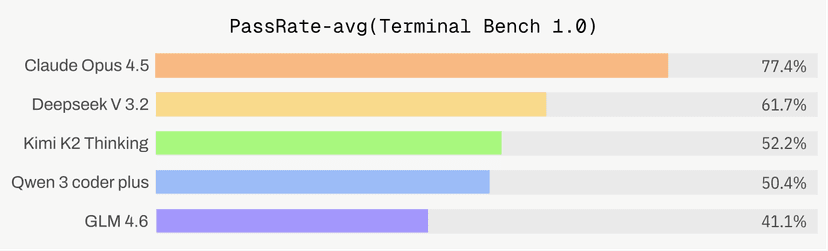
Ignite Team's work on Terminal-Bench starts from a clear principle: difficulty alone is not enough—difficulty must correspond to _economically valuable work_. Rather than inflating complexity through artificial constraints or brittle tricks, Ignite focuses on tasks that require genuine reasoning, exploration, and decision-making of the kind professional engineers are paid to perform. Each task is calibrated to sit in the “productive failure zone”: simple agents fail quickly, while stronger agents must reason through environment inspection, error diagnosis, tool usage, and iterative correction. This preserves the benchmark’s meaningful performance ceiling while ensuring known solutions remain attainable for sufficiently capable systems.
Economic relevance over academic novelty
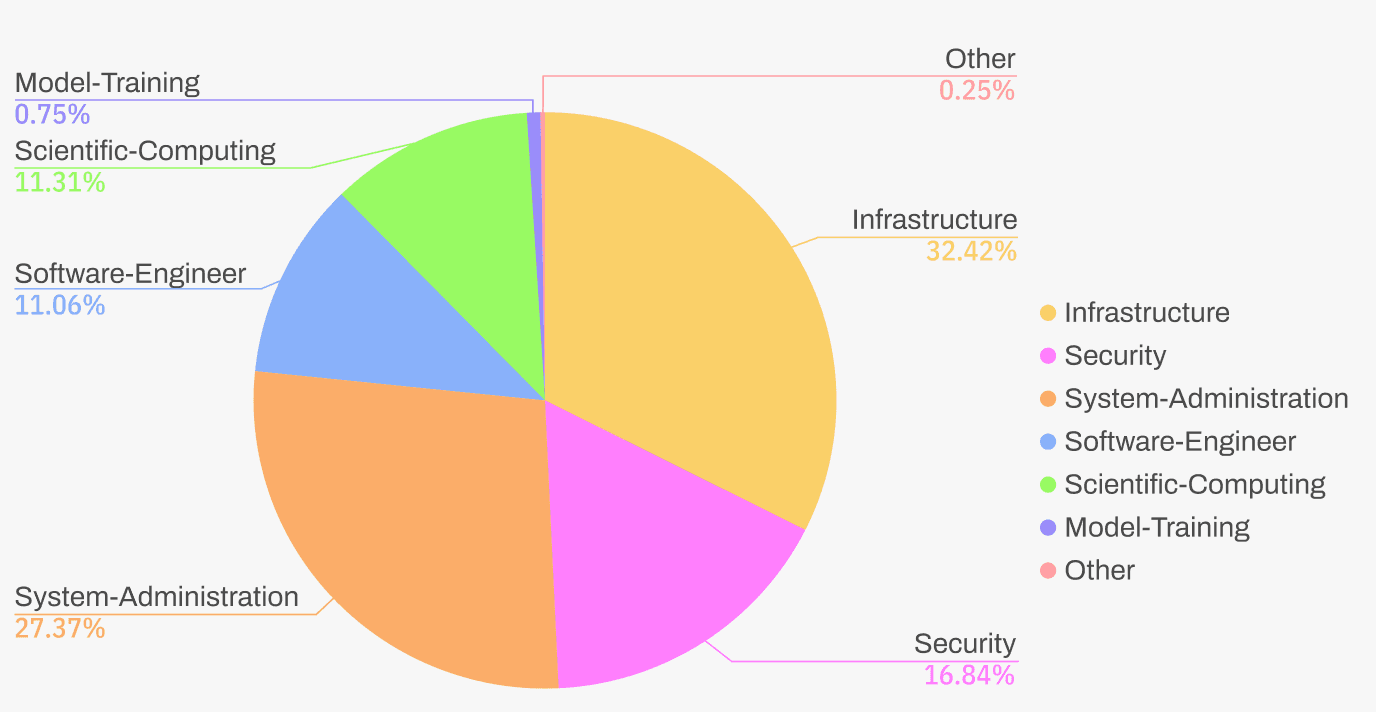
A core contribution of Ignite Team is the systematic removal of tasks that are technically interesting but economically hollow. Tasks that reduce to scripted execution, rote file manipulation, or one-shot commands—while common in earlier benchmarks—are deliberately excluded. Instead, Ignite prioritizes scenarios that mirror real-world engineering work: debugging misconfigured systems, repairing broken build pipelines, resolving dependency conflicts, validating data processing logic, or enforcing security and correctness constraints under ambiguity. To achieve this goal, we invited 294 experienced engineers with established careers—many of whom have built large-scale systems at companies such as TikTok and WeChat—to design and curate the problem set. The result is a benchmark that better reflects real labor value, not just benchmark progress.
Reproducibility as a first-class constraint
Beyond task difficulty, Ignite invested heavily in reproducibility and determinism—areas where many terminal-based benchmarks silently fail. Every contributed task is validated end-to-end in a controlled container environment, with explicit guarantees that:
- The task is solvable from a clean initial state
- The reference solution passes all tests deterministically
- No external network, timing, or randomness leaks into evaluation
This extra effort ensures that failures reflect model limitations, not environment instability or poorly specified tests.
Precision in test design and reward signals
Ignite Team goes beyond "does it pass" validation by carefully auditing how tasks are judged. Tests are designed to be tight but fair: they verify exactly what the prompt asks for—no more, no less. Special attention is paid to avoiding common benchmark pathologies:
- Overly strict tests that encode implementation details not stated in the prompt
- Overly loose tests that allow incorrect or partial solutions to pass
- Hidden assumptions about file paths, formats, or tooling
This precision directly improves the quality of reward signals for training and evaluation, making the dataset suitable not only for benchmarking but also for outcome-based reinforcement learning.
Difficulty measurement grounded in agent behavior
Rather than relying on subjective labels, Ignite Team uses agent-driven evaluation to quantify task difficulty. Tasks that are consistently solved by baseline agents are rejected as too easy, regardless of how “complex” they appear on paper. Conversely, tasks that fail only due to prompt ambiguity or test fragility are revised instead of being misclassified as hard. This behavior-first approach aligns difficulty with actual model performance, ensuring the data remains sensitive to real capability improvements.
Extra effort beyond the original benchmark
On top of the original Terminal-Bench QA framework, Ignite introduced several additional layers of rigor:
- Multi-stage quality funnels combining automated checks with deep human review
- Failure-mode analysis using agent execution logs to trace whether failures stem from model reasoning, prompt design, tests, or environment issues
- Explicit value screening, rejecting tasks that lack exploration space or reduce to mechanical execution
- Consistency checks across prompt, solution, tests, and environment to eliminate hidden contradictions
These steps significantly raise the cost of task production—but also dramatically increase the signal quality of the final dataset.
Outcome
The result of Ignite Team's work is a set of Terminal-Bench tasks that are not only harder, but meaningfully harder: reproducible, economically grounded, and diagnostically useful. We distinguish agents that can truly operate in realistic terminal environments from those that merely pattern-match, helping ensure that progress on the benchmark reflects progress in real-world capability.